


For Professional Clients Only
Macro & Market Update
Market movements took precedence over macroeconomic developments in July as the nervousness around AI trades that started brewing in June snowballed to create a high level of volatility. As we mentioned in last month’s commentary, there have been growing concerns about the amount of money spent by hyperscalers such as Alphabet, Amazon, Meta and Microsoft on data centres because of the lack of visibility on future returns on capital. The AI revolution is real, but nobody can yet predict who the winners will be, how it will be monetized nor how much computing power it will require. As such, while it is understandable that large technology companies try to ensure they stay in the race (particularly given the vast amount of cash available to them), it is equally understandable that investors finally question how they will get their money back. The Nasdaq index, a bellwether in the US for technology companies, entered a correction in July as a result (the term used to describe a 10% drop from the most recent peak). Until recently, however, chip manufacturers such as Nvidia in the US or Samsung and SK Hynix in South Korea were seen as the better way to play the AI theme. Irrespective of which AI model wins the race, all of them need a huge amount of computing power and semiconductors are necessary to achieve it. Thanks to huge order books providing these companies with visibility in revenues for the next few years, a lot of investors have flocked into their shares to generate extraordinary returns. As an illustration, SK Hynix went up about 900% in the year to the end of June 2026. The company went on to fall close to 60% at its worst in July, however, on the back of disappointing results. This shows how, when investors’ expectations become disconnected from reality and momentum takes a life of its own, risks get amplified. This is not to say we are at the stage where the bubble bursts yet, and such moves are often part of price patterns during periods of exuberance. Volatility of this sort has to be factored into the latter stages of a strong market like we are in now, however. Given how dominant the AI theme has been for months, movements of that magnitude certainly are noticeable, but it is encouraging to see that non-tech-related stocks generally performed strongly, helped by more attractive valuations and an acceleration in corporate activity (mergers and acquisitions), which led to a rotation towards less expensive names.
Bonds were also volatile in July, driven by higher oil prices -and thus fear of inflation and higher interest rates, but also by poor communication from the US central bank (or Fed). Oil prices went from $70 a barrel at the start of the month to $105 when the ceasefire in the Strait of Hormuz came to an end and tit-for-tat attacks between Iran and the US took place over a number of days. It ended the month lower at $87. The ceasefire was always fragile given the lack of trust between both parties, but it is now unclear how the strait can sustainably reopen in the short term. While inflation in both the US and the UK surprisingly came down and no central bank increased rates over the month, higher energy prices put bond investors on the defensive. Moreover, the new Chair of the Fed, Kevin Warsh, is intent on stopping guidance to market participants with the view that markets should price in data and react to it, rather than pricing in how they think the Fed will react to the data. As he put it, he wants “market participants to learn to play the ball, not the referee”. This certainly has merits and it can easily be argued that investors have got too hung up on every word, punctuation and omission from central bankers’ speeches, but markets still need to have an inkling about how strict or lenient the referee will be so they can adjust their play. This uncertainty sent the 30-year US bond yields to their highest level since 2007, impacting cost of borrowing, and it seems that Warsh will need to improve and polish his communication skills going forward to avoid losing credibility and control of the bond market.
In other news, Trump found a new way to impose tariffs of at least 10% on 60 countries, including the UK, EU and Japan, after his first attempt on “Liberation Day” last year was ruled illegal. This new tool is linking tariffs to the alleged failure of those countries to enforce the prohibition on importation of goods produced with forced labour, a relatively obscure rule used with little evidence of wrongdoing from the recipients which will surely trigger reciprocal measures and continue to disturb global trade and relationships. Finally, China’s domestic consumption and investment woes came through in their latest GDP growth figure, at its lowest level since at least the early 1990s, coming in at 4.3% per annum, below its 4.5-5% target announced for 2026.
Fund Performance
Wise Multi-Asset Growth
In July, the IFSL Wise Multi-Asset Growth Fund rose 2.2%, behind the CBOE UK All Companies Index (+3.9%) but ahead of its peer group, the IA Flexible Investment sector (-0.7%). The main contributor was RIT Capital Partners which benefitted from the SpaceX listing, forcing a revaluation of its holding last valued in December 2025 (private holdings are usually only revalued twice a year). It also announced a tender offer (a proposal by the company to buy a set number of shares from shareholders) which pushed the discount sharply tighter. Our UK equity funds also performed strongly, helped by accelerating merger and acquisition activity, including for Odyssean with a bid at a 41% premium for one of their top holdings. Finsbury Growth and Income also benefitted from strong earnings reports from holdings Sage and RELX helping to put fears of AI cannibalisation at bay, as well as Unilever and Burberry. In Private Equity, Oakley Capital recovered its losses from June. On the negative side, Mobius and Templeton in emerging markets gave some of their recent strong gains back, as did International Biotechnology Trust.
Wise Multi-Asset Income
Against this backdrop, the IFSL Wise Multi-Asset Income Fund rose 3.2% during July, outperforming the IA Mixed Investment 40–85% Shares sector, which fell 0.5%. The broadening of market leadership proved particularly supportive for the portfolio. As investors rotated away from highly valued technology stocks towards more attractively valued areas of the market, the Fund benefited from its exposure to UK equities, value-oriented global managers and real assets, while having relatively limited exposure to many of the weaker performing technology and semiconductor names.
UK equities were among the strongest contributors to performance. Holdings including Fidelity Special Values, Odyssean Investment Trust, Finsbury Growth & Income Trust, Paragon Banking Group and Legal & General all delivered strong returns as investors increasingly recognised the attractive valuations available within the UK market. The combination of resilient economic data, improving political stability and continued merger and acquisition activity provided a supportive backdrop. Paragon Banking Group also reported another encouraging trading update, with robust loan growth, improving credit quality and continued capital generation. The portfolio also benefited from its exposure to global and emerging market managers with a strong valuation discipline. These portfolios remain significantly underweight many of the semiconductor companies that now dominate global and Asian equity indices.
As enthusiasm surrounding the AI theme moderated, this positioning proved beneficial. Holdings such as Brickwood Global Value, Schroder Global Equity Income, Prusik Asian Income and Neuberger Berman Emerging Markets held up well relative to broader indices. In Asia in particular, index performance has become increasingly concentrated in a small number of semiconductor companies, leaving diversified, valuation-focused managers looking markedly different from their benchmarks. Property and infrastructure holdings also contributed positively. Trading updates from British Land, LondonMetric and Helical continued to demonstrate healthy occupier demand, rental growth and active asset management. Corporate activity across the sector, including the proposed acquisition of SEGRO and the continuing interest in Picton Property Income, reinforce our view that high-quality property assets remain attractively valued. Limited new supply, elevated replacement costs and resilient occupier demand continue to support rental growth, while infrastructure holdings also benefited from positive strategic updates and asset disposals completed at values well above prevailing share price discounts, highlighting the disconnect between public market valuations and underlying asset values.
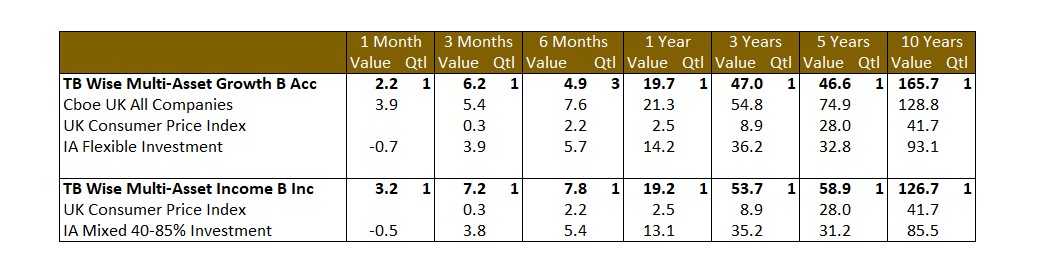
All data is in a total return format
Past performance is not a guide to future performance
Portfolio Changes
Wise Multi-Asset Growth
In terms of portfolio activity, we took some profits in RIT Capital Partners, Odyssean, Pacific North of South Emerging Equity Income, RTW Biotech Opportunities and Aberforth Smaller Companies. We also reduced our holding in Achilles Investment Company. We used those proceeds to top up Neuberger Berman Emerging Markets Fund, Finsbury Growth & Income, Pershing Square and AVI Global. Our cash levels remained on the cautious side at 4.3%.
Wise Multi-Asset Income
During the month we exited Pantheon Infrastructure following a strong period of performance and a narrowing of its discount to net asset value, reduced GCP Infrastructure and added to VH Global Energy Infrastructure. Within property, we switched part of our holding in British Land into TR Property and Helical following strong relative performance, while switching LondonMetric into Picton Property Income to benefit from the proposed transaction between the two. Within emerging markets, we reduced Pacific North of South Emerging Market Equity Income and increased our holdings in Neuberger Berman Emerging Markets and Prusik Asian Income. Finally, following a period of exceptionally strong performance, we reduced International Biotechnology Trust and recycled proceeds into Fidelity Special Values and Brickwood Global Value.
TO LEARN MORE ABOUT THESE FUNDS, PLEASE CONTACT
01608 695 180 OR EMAIL JOHN.NEWTON@WISE-FUNDS.CO.UK
WWW.WISE-FUNDS.CO.UK
Full details of the IFSL Wise Funds, including risk warnings, are published in the IFSL Wise Funds Prospectus, the IFSL Wise Supplementary Information Document (SID) and the IFSL Wise Key Investor Information Documents (KIIDs) which are available on request and at wise-funds.co.uk/our funds. The IFSL Wise Funds are subject to normal stock market fluctuations and other risks inherent in such investments. The value of your investment and the income derived from it can go down as well as up, and you may not get back the money you invested. Capital appreciation in the early years will be adversely affected by the impact of initial charges and you should therefore regard your investment as medium to long term. Every effort is taken to ensure the accuracy of the data used in this document but no warranties are given. Wise Funds Limited is authorised and regulated by the Financial Conduct Authority, No768269. Investment Fund Services Limited is authorised and regulated by the Financial Conduct Authority, No. 464193.