


For Professional Clients Only
Macro & Market Update
It was a volatile month for financial markets in June. Although the month started with ongoing strikes and tensions between the US/Israel and Iran, a temporary deal was eventually agreed between the two sides allowing negotiations towards more permanent arrangements to take place within a 60-day ceasefire framework. Crucially, the memorandum of understanding (MoU) between the US and Iran agreed the immediate re-opening of the Strait of Hormuz which helped Brent crude oil drop from about $100 a barrel down to $70 over the period. As has been the case since the conflict began, however, while a definite improvement and a great step forward, it is too early to call the end of the war for good. The MoU is not equivalent to a peace deal and lacks detail. Also, both sides lack trust in each other and fire continued to be exchanged later in the month despite the ceasefire. The Iranian regime accepted the deal in order to receive an immediate financial boost by being allowed to sell its oil again, while President Trump is under increasing pressure to turn the page on a war of choice that is diminishing his authority within his own party, as well as threatening his legacy.
Despite some necessary caution, the above was undeniably good news for investors, but the moderate market reaction highlighted that this was already priced in after a strong period of performance for equities since the beginning of April, illustrating the adage that it often is better to travel than to arrive. The reaction was more positive in bond markets where inflation fears from higher energy prices had driven yields higher in longer-dated bonds (10+ years). The deal with Iran relieved some of that pressure. At the shorter-end, rather than inflation per se, it is central banks’ interest rate decisions that tend to drive bond yields, and we saw some diverging reactions between regions in June. The European Central Bank was the first one to hike rates due to inflationary pressures on energy prices from the war, its first since mid-2023, although it was in line with market expectations. The Bank of Japan also hiked but has been on a different interest rate path from other developed economies for years. The Bank of England (BoE) kept its base rate unchanged, helped by a surprise steady inflation reading of 2.8% last month. Although this is expected to only be a temporary reprieve, the BoE is hoping that it will not have to put on the brakes to combat inflation while growth in the UK remains weak. It will also keep a close eye on the plans from the new leader of the Labour Party over the next few weeks, following the resignation of Prime Minister Starmer. The US central bank (the Federal Reserve or Fed) was the most significant for markets, despite keeping its rate unchanged. It was the first meeting of Chair Warsh, appointed by Trump and under explicit pressure from the President to lower interest rates. With inflation during the month coming in at 4.2% vs 2.4% prior to the Iran war, with stronger than expected employment numbers in June, and with strong retail sales, Warsh and the Fed committee instead strongly hinted at a readiness to hike rates over the next few months. As such, bond investors went from pricing in no rate hike this year to one hike by December.
This change in interest rate expectations in the US put the most growth-oriented part of the equity market (the names reliant on future earnings to justify their current valuations) under pressure. At the same time, we are clearly starting to see increasing questioning from investors about the future profitability of the gigantic spending in AI-related projects. Capital expenditure from the largest hyperscale tech companies went from $412bn in 2025 to an estimated $754bn in 2026 and $905bn in 2027 according to Goldman Sachs. Increasingly, rather than relying on their own cashflows, these hyperscalers are raising capital from both equity and bond markets and the pricing of these raises suggests that investors are less willing to write them blank checks. As a result, an equally-weighted basket of the Magnificent 7 (Alphabet, Amazon, Apple, Meta, Microsoft, Nvidia and Tesla) fell more than 14% peak-to-trough in June. Even the largest company listing in history, Space X, dropped by a third after its first week of trading. That said, the AI trade remains alive and well, but it is the “picks and shovels” names like semiconductor manufacturers that are now favoured over the AI model developers. A final related point worth keeping an eye on for equity markets is when all this capital raising will run out of buyers. 2026 will be the first year since 2003 when more US shares are issued than bought back from companies. The former era provided a huge boost to equity valuations, but this may be slowly changing.
Fund Performance
Wise Multi-Asset Growth
In June, the IFSL Wise Multi-Asset Growth Fund rose 0.3%, behind the CBOE UK All Companies Index (+0.5%) but in line with its peer group, the IA Flexible Investment sector (+0.3%). We have purposedly avoided direct AI trades because we cannot make sense of valuations. AI affects most sectors, however, from infrastructure to commodities, or from financials to biotechnology to name but a few. We also have exposure to AI themes via heavily discounted investment trusts (e.g. private equity, infrastructure, value equity), giving us sufficient margin of safety to participate on the upside. Some of those had a difficult month in June, like Pershing Square which has built exposure to some Magnificent 7 companies recently on weakness, or Oakley Capital which has exposure to technology companies. Meanwhile, the competition for capital driven by some of the new equity issuances mentioned above, drained capital from other parts of the market, like precious metals for example, impacting Jupiter Gold & Silver and Blackrock World Mining. Finally, AVI Global had a difficult month driven by stock-specific weaknesses as well as some profit taking in Korea.
On the positive side, our biotechnology names continued to benefit from acquisitions of their holdings by large pharmaceutical companies. Our infrastructure basket also contributed positively, supported by lower long-term bond yields. Finally, in emerging markets, Mobius Investment Trust continued its strong run since the start of the quarter.
Wise Multi-Asset Income
In June, the IFSL Wise Multi-Asset Income Fund delivered a total return of 0.4%, marginally behind the IA Mixed Investment 40–85% Shares sector, which returned 0.5%. While the broader market environment remained supportive for risk assets, there was notable divergence in performance within asset classes by geography, size and sector exposure over the month. The strongest contribution came from the Fund’s specialist biotechnology holding, International Biotechnology Trust, which benefited from an acceleration in merger and acquisition activity across the sector. Two of the Trust’s portfolio companies, Apogee Therapeutics and Nuvalent, received takeover offers at substantial premiums from AbbVie and GSK respectively. These transactions reinforced the investment team’s strategy of identifying businesses with innovative assets that are strategically valuable to larger pharmaceutical companies seeking to replenish drug pipelines ahead of significant patent expires. Financials also contributed positively, led by Paragon Banking Group. The company reported another strong set of results, supported by resilient lending growth, robust net interest margins and continued credit quality. Management also announced a further £50 million share buyback alongside the disposal of its Specialist Fleet Services business. The update demonstrated how disciplined capital allocation and shareholder-friendly balance sheet management continue to create value independently of the wider economic backdrop.
Infrastructure holdings delivered steady returns as lower UK gilt yields supported valuations. International Public Partnerships continued to demonstrate resilient operational performance across its core infrastructure portfolio while recycling capital into higher-return opportunities. GCP Infrastructure Investments also made further progress through refinancing activity and selective asset disposals, enhancing balance sheet flexibility and supporting future share buybacks. Sentiment across the wider listed infrastructure and renewable energy sector was further supported by ongoing corporate activity, with the bid from Drax for Bluefield Solar emerging at a tighter discount to net asset value than expected, alongside the disposal of the Beatrice Offshore Wind Farm by The Renewables Infrastructure Group. These transactions highlighted the disconnect between prevailing market discounts and observable transaction prices for high-quality renewable assets, helping to underpin sector valuations and reinforce confidence in underlying asset values.
Within property, performance reflected the growing divergence between prime assets and the wider commercial real estate market. Helical reported encouraging leasing activity, with occupancy continuing to improve and rental agreements in line with estimated rental values, demonstrating the resilience of high-quality London office space. Positive updates from British Land, together with an unsolicited takeover offer for Segro, the UK’s largest REIT (Real Estate Investment Trust) also supported sentiment across listed real estate, helping narrow discounts to net asset value.
Offsetting these positive contributions, international value-oriented equity strategies faced headwinds as the stronger US dollar and higher US interest rate expectations weighed on emerging market and Asian income strategies. Commodity-related holdings were the principal detractors following the sharp decline in oil prices after tensions in the Middle East eased, while weaker industrial metal prices reflected softer expectations for Chinese demand.
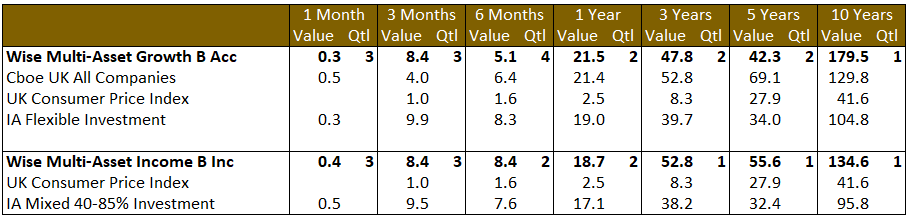
All data is in a total return format
Past performance is not a guide to future performance
Portfolio Changes
Wise Multi-Asset Growth
In terms of portfolio activity, we trimmed strong performers International Biotechnology Trust and Foresight Environmental Infrastructure. We redeployed the proceeds, as well as some of the cash we had accumulated in recent weeks, into what we think are attractively valued opportunities: Neuberger Berman EM Markets, Jupiter Gold & Silver, Oakley Capital Investments and TR Property. Our cash remains higher than average, ready to be reinvested during further market weakness.
Wise Multi-Asset Income
Over the month, we exited our holding in Workspace, where management face a protracted turnaround story which requires reasonably high levels of capital investment. We reinvested those proceeds back into the sector adding to our holding in Helical, whose share price performance appears disconnected from the recent positive operational performance and where the prospects for high-quality central London office development appear strong given the very tight supply/ demand backdrop. We also added to sector specialist TR Property and Picton Property Income. Elsewhere, we reduced Foresight Environmental Infrastructure following strong performance and added to the Neuberger Emerging Markets Equity Fund.
TO LEARN MORE ABOUT THESE FUNDS, PLEASE CONTACT
01608 695 180 OR EMAIL JOHN.NEWTON@WISE-FUNDS.CO.UK
WWW.WISE-FUNDS.CO.UK
Full details of the IFSL Wise Funds, including risk warnings, are published in the IFSL Wise Funds Prospectus, the IFSL Wise Supplementary Information Document (SID) and the IFSL Wise Key Investor Information Documents (KIIDs) which are available on request and at wise-funds.co.uk/our funds. The IFSL Wise Funds are subject to normal stock market fluctuations and other risks inherent in such investments. The value of your investment and the income derived from it can go down as well as up, and you may not get back the money you invested. Capital appreciation in the early years will be adversely affected by the impact of initial charges and you should therefore regard your investment as medium to long term. Every effort is taken to ensure the accuracy of the data used in this document but no warranties are given. Wise Funds Limited is authorised and regulated by the Financial Conduct Authority, No768269. Investment Fund Services Limited is authorised and regulated by the Financial Conduct Authority, No. 464193.