


For Professional Clients Only
Macro & Market Update
The conflict in Iran remained central to the market outlook in September, not only through its impact on energy supplies but increasingly through inflation and the cost of borrowing. Renewed hostilities following August’s relative calm pushed Brent crude oil above $108 a barrel during the month, while European natural gas reached its highest level since early 2023. With European gas storage only 63% full in late August, the approach of winter added to concerns about both availability and affordability. The problem also extended beyond the Strait of Hormuz. Attacks on Saudi Arabia’s East-West pipeline and the advance of Iran-backed Houthi forces towards the southern entrance to the Red Sea threatened alternative export routes, limiting the ability to redirect supplies. Despite renewed US-Iran talks later in the month, no real progress took place. For investors, the important question remained whether higher energy costs would prove temporary or become embedded in wider price-setting and inflation expectations.
Bond markets increasingly reflected the latter risk. All long-term bond yields across developed markets pushed through multi-year highs in September increasing financing costs and the returns against which other investments must compete. Inflation fears were amplified by concerns of deficits getting out of control, leading to those sharp moves in the bond market. At the same time, the US economy continued to demonstrate considerable strength. An August employment increase largely beat expectations, while September’s business surveys showed output expanding at its fastest pace in five years. This was encouraging for the growth outlook but less helpful for investors hoping that weaker demand would contain inflation. Headline inflation remained at 3.4%, although core inflation (which excludes food and energy) eased. In the UK, inflation rose to 3.1%, but weaker employment and subdued private-sector wage growth provided a counterweight to higher energy prices. In the Eurozone, inflation accelerated to 3.3%, particularly hit by the higher gas prices we mentioned earlier. Against this backdrop, central banks had difficult decisions to make. In the US, the Federal Reserve raised interest rates by 0.25%, its first increase since 2023. The unanimous decision, despite President Trump’s demands for lower borrowing costs, underlined the priority given to controlling inflation. The European Central Bank also increased its deposit rate by 0.25%, its second rise since June. Neither decision resolved the underlying supply problem, but both reflected concern that allowing inflation to remain above target for longer could make it harder to bring back under control. The Bank of England was more cautious, holding rates but warned that policy might need to tighten. The next big event investors will be focusing on is the Autumn Budget on 28th October. Higher borrowing costs are eating into the fiscal headroom, limiting the scope for additional spending so ambitious political promises might need curtailing or tax increases will be required. The sharp rise in bond yields left equity investors on the defensive, with most markets struggling to make headway during the month. AI stole the limelight again, presenting a combination of opportunity and risk. Leading industry executives called for a slower pace of development as concerns grew that increasingly capable systems were advancing faster than safeguards. These concerns did not prevent renewed enthusiasm, however, with the index of leading technology companies in the US reaching a record high, helped in part by strong performance from Meta (owner of Facebook and Instagram) which released its new AI assistant. The contrast illustrated how quickly sentiment could switch between concerns about the technology and excitement about its commercial potential. There was hope that the question of AI security would be discussed between Presidents Trump and Xi during the US-China summit but this issue and the important one related to rare earth minerals was avoided with the summit producing more breathing space than any meaningful breakthrough. The trade truce was extended from November to January, alongside a lower-tariff arrangement covering $60bn of non-sensitive goods. These were useful but limited outcomes, rather than a broader resolution of the strategic disagreements between the two countries.
Fund Performance
Wise Multi-Asset Growth
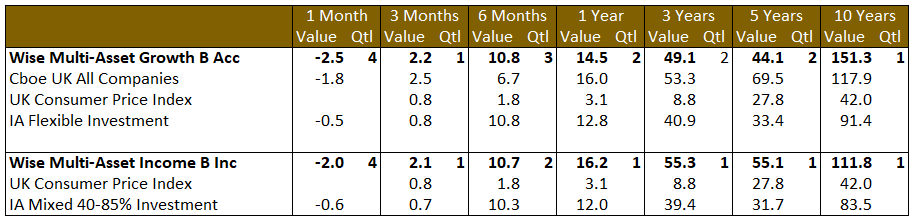
In September, the IFSL Wise Multi-Asset Growth Fund fell 2.5%, behind both the CBOE UK All Companies Index (-1.8%) and its peer group, the IA Flexible Investment sector (-0.5%). In a reversal from last month when fiscal concerns helped boost gold prices, both the Jupiter Gold & Silver Fund and BlackRock World Mining gave back some of their recent gains. Rising bond yields had the most direct impact on the property sector in the portfolio and TR Property was thus a strong detractor. Private equity is also perceived as interest rate sensitive due to the leverage embedded in its structure, which impacted the discounts on the trusts. We had updates from all of our private equity managers during September, however, and all of them confirmed either their lack of financing needs or their ability to refinance at attractive terms due to their size and reputation. We thus would not expect rates at current levels to have much of an impact on their Net Asset Values (NAVs). Software companies were weak again due to the ongoing fear of AI taking over their business combined with higher yields creating a valuation headwind for companies relying on long-term growth. This impacted HG Capital Trust and Finsbury Growth & Income. Finally, Pershing Square in US equities saw its discount widen and mixed performance between its technology names (including Meta) and the rest of its portfolio. The two main positive contributors to performance were Mobius Investment Trust in emerging markets and Achilles Investment Company which jumped to its highest level of the year following the completion of the acquisition of Spire Healthcare at a substantial premium.
Wise Multi-Asset Income
The IFSL Wise Multi-Asset Income Fund fell 2.0% during September, compared with a 0.6% fall from the IA Mixed Investment 40–85% Shares sector, reversing some of the strong relative gains generated earlier in the year. Property was the largest source of weakness, with rising government bond yields putting renewed pressure on listed property companies. TR Property made the largest negative contribution, alongside Helical, British Land, Schroder Real Estate and LondonMetric. Share prices weakened despite generally encouraging underlying operational performance, including rental growth, occupier demand and asset-management activity. Infrastructure holdings also came under pressure. HICL Infrastructure and International Public Partnerships declined despite encouraging company-specific developments. VH Global Energy Infrastructure was weaker after announcing its first portfolio disposals under its strategy to realise investments and return capital to shareholders. The transactions have been completed or agreed below previous carrying values, but materially above the values implied by the heavily discounted share price. Our private equity holdings were also weaker, with CT Private Equity and ICG Enterprise both falling during the month. We met both managers during September and remain encouraged by the progress of their underlying companies. Profits continue to grow strongly and both trusts have been successfully selling investments at or above their reported valuations. These sales provide useful evidence that the valuations at which the investments are held are realistic, at a time when some investors remain sceptical about private-market valuations. Another concern has been private equity’s exposure to highly valued software businesses, particularly given uncertainty over the impact of AI. However, software represents a relatively small proportion of both portfolios, with ICG Enterprise’s exposure around 12% and its managers having deliberately avoided many of the most highly valued transactions. Despite this progress, both trusts continue to trade at substantial discounts to net asset value. BlackRock World Mining and BlackRock Energy & Resources Income also declined as higher bond yields and a stronger US dollar weighed on mining shares following their strong performance earlier in the year.
There were, however, some areas of positive or relatively resilient performance. UK smaller companies performed relatively well, with Aberforth Smaller Companies and Odyssean Investment Trust contributing positively. The Renewables Infrastructure Group and Foresight Environmental Infrastructure also rose, with higher power-price expectations helping to offset the impact of rising bond yields. Our fixed-income holdings were comparatively resilient, including CVC Income & Growth and TwentyFour Income Fund. Both have significant exposure to floating-rate loans and bonds, where interest payments adjust as rates change, supporting income while reducing sensitivity to movements in government bond yields.
All data is in a total return format
Past performance is not a guide to future performance
Portfolio Changes
Wise Multi-Asset Growth
In terms of portfolio activity, we added a new position in the Vontobel TwentyFour Multi-Asset Credit Fund, managed by the same team as the Vontobel TwentyFour Strategic Income Fund we already own but with more emphasis on generating performance purely from credit (i.e. company-issued bonds) with no government bond exposure. We believe the current environment should be opportune for expert managers who can generate returns from pure stock selection, avoiding the general macroeconomic noise. We also started a position in Rockwood Strategic which complements our existing smaller-company exposure by investing in some of the smallest companies on the UK stock market, seeking undervalued businesses where changes in management, operational improvements, restructuring or takeover activity can help unlock value. On the back of strong absolute and relative performance, we exited our position in Pantheon International in the private equity space. Otherwise, we added on weakness to Finsbury Growth & Income, HG Capital, Pershing Square and TR Property, while continuing to build up the position in MIGO Opportunities. Those were financed by taking some profit in infrastructure names, as well as Odyssean and RIT Capital Partners.
Wise Multi-Asset Income
We made several portfolio changes during September. Within UK equities, we initiated holdings in Temple Bar Investment Trust and Rockwood Strategic, funded by reductions in Man Income, Odyssean and Legal & General following strong year-to-date performance. Temple Bar follows a disciplined value approach, investing where its managers believe excessive pessimism has left share prices materially below their underlying worth. Rockwood complements our existing smaller-company exposure by investing in some of the smallest companies on the UK stock market, seeking undervalued businesses where changes in management, operational improvements, restructuring or takeover activity can help unlock value. We also initiated a holding in the TwentyFour Multi-Asset Credit Fund. Its flexible approach allows the managers to invest across different areas of global credit as opportunities change, seeking attractive income and returns while limiting interest-rate exposure. Finally, we added to CT Private Equity following recent share-price weakness.
TO LEARN MORE ABOUT THESE FUNDS, PLEASE CONTACT
01608 695 180 OR EMAIL JOHN.NEWTON@WISE-FUNDS.CO.UK
WWW.WISE-FUNDS.CO.UK
Full details of the IFSL Wise Funds, including risk warnings, are published in the IFSL Wise Funds Prospectus, the IFSL Wise Supplementary Information Document (SID) and the IFSL Wise Key Investor Information Documents (KIIDs) which are available on request and at wise-funds.co.uk/our funds. The IFSL Wise Funds are subject to normal stock market fluctuations and other risks inherent in such investments. The value of your investment and the income derived from it can go down as well as up, and you may not get back the money you invested. Capital appreciation in the early years will be adversely affected by the impact of initial charges and you should therefore regard your investment as medium to long term. Every effort is taken to ensure the accuracy of the data used in this document but no warranties are given. Wise Funds Limited is authorised and regulated by the Financial Conduct Authority, No768269. Investment Fund Services Limited is authorised and regulated by the Financial Conduct Authority, No. 464193.