

Wise Multi-Asset Growth
Fund Ratings



Investment Objective
The investment objective of the Fund is to provide capital growth over Rolling Periods of 5 years in excess of the Cboe UK All Companies Index and in line with or in excess of the Consumer Price Index, in each case after charges.
Fund Attributes
- Aims to provide long term capital growth (over 5 year rolling periods) ahead of the Cboe UK All Companies Index and inflation.
- Specialised focus on investment trusts across asset classes.
- Adopts a value bias investment approach.
- Focus on high-quality funds and investment trusts investing in out-of- favour areas.
- Preference for fund managers with a disciplined, easy-to-understand investment process.
Investor Profile
- Seek capital growth over a long time frame.
- Accept the risks associated with the volatile nature of an adventurous multi-asset investment.
- Plan to hold their investment for the long term, 5 years or more.
Key Details
| Target Benchmark | Cboe UK All Companies, UK CPI |
|---|---|
| Comparator Benchmark (Sector) | IA Flexible Investment |
| Launch date | 1st April 2004 |
| Fund value | 71.7 million |
| Holdings | 40 |
| Valuation time | 12pm |
- Past performance is not a guide to the future
- Data as at 31st August 2026
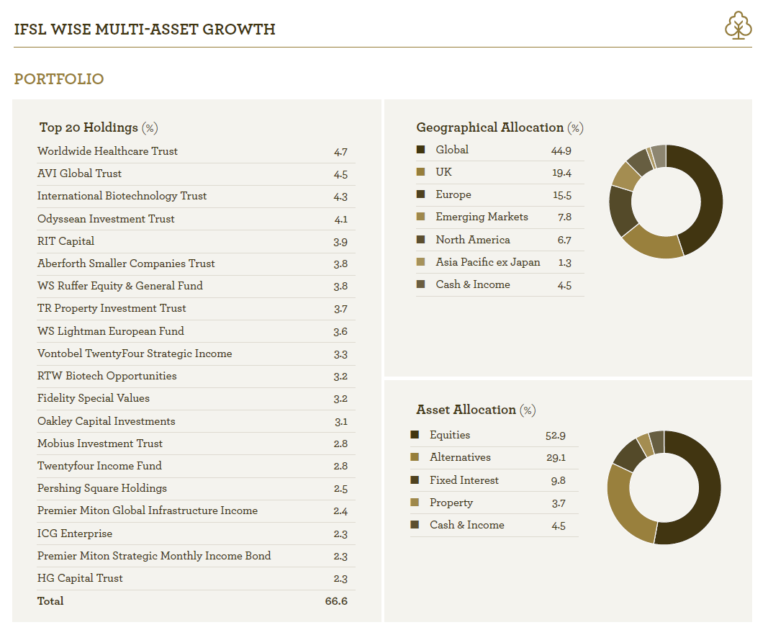
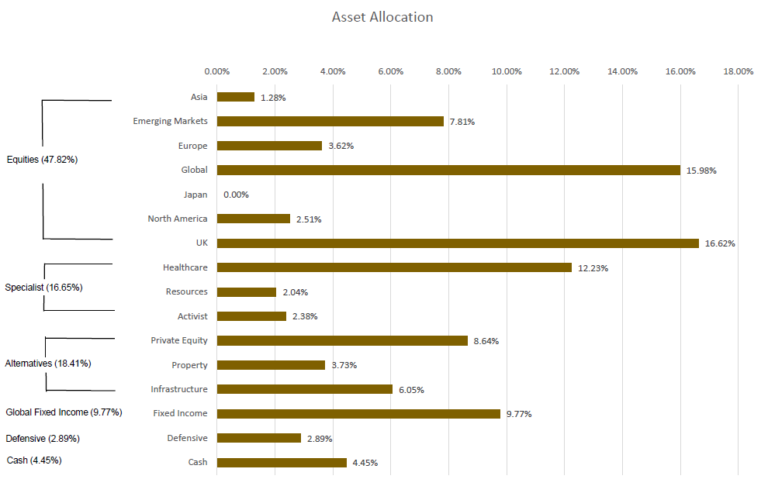
Investment Portfolio - August 2026
- Past performance is not a guide to the future
- Data as at 31st August 2026
Share Class Information
| | B Acc (Clean) | W Acc (Institutional) |
|---|---|---|
| Sedol Codes | 3427253 | BD386X6 |
| ISIN Codes | GB0034272533 | GB00BD386X65 |
| Minimum Lump Sum | £1,000 | £100 million |
| Initial Charge | 0% | 0% |
| IFA Legacy Trail Commission | Nil | Nil |
| Investment Management Fee | 0.75% | 0.50% |
| Operational Costs | 0.16% | 0.16% |
| Fund Management Costs | 0.23% | 0.23% |
| Ongoing Charges Figure 12 | 1.14% | 0.89% |
All performance is still quoted net of fees.
- The Ongoing Charges Figure is based on the expenses incurred by the fund for the period ended 28th February 2026.
- Includes Investment Management Fee, Operational costs and look-through costs.
The figures may vary year to year
Fund Commentary - August 2026
The main macroeconomic development in an otherwise relatively quiet August was concerns about long-term borrowing costs in developed countries. The yields on sovereign bonds are an indication of the interest investors are willing to accept in exchange for lending money to a government. They are a function of a number of factors such as the expected future path of short-term interest rates fixed by central banks, future inflation expectations, future growth prospects, the likelihood of the government repaying its debt and the maturity of the bond (the longer the maturity, the more uncertainty about future events, requiring extra compensation). In August, the yield on 30-year US bonds pushed through to the highest in almost 20 years. While this is the move that grabbed headlines, long-term government bond yields have been rising rapidly across developed countries over the past few years to reach levels not seen for decades: Germany’s 30-year government bond yields are the highest since 2011, France’s since 2008, the UK’s are close to levels last seen in 1998 and Japan’s are close to all-time highs. While a strong recovery in growth, particularly since the Covid crisis, explains part of this rise, the main drivers of late have been an uncertain inflationary outlook due to the ongoing war in Iran and, maybe more importantly, worries from bond investors about government fiscal irresponsibility. In the US, the national debt reached a record $40 trillion this month with a staggering $3 trillion added in the last year alone due to a ballooning federal budget deficit (when government spending outpaces its tax revenues). The US government now spends roughly $1 trillion annually purely on interest payments, which makes it a larger expense than the entire defence or healthcare budget.
Long-term government bond yields are not just of interest to economists, they matter for investors too on two levels. Firstly, higher bond yields make riskier assets such as equities less attractive by comparison. Secondly, bond yields are a reflection of investor confidence and rapidly rising yields like we have seen recently suggest nervousness in some quarters of financial markets. They also have real-life impacts on consumers, notably on loans and mortgages, which may impact their ability and willingness to spend elsewhere. In August, the US Treasury indicated it was getting concerned about the level of long-term government bond yields and announced measures to increase its purchase of 30-year bonds (thus trying to push the yield down) while selling some shorter-dated bonds. It failed to have the desired effect so far, not only because investors tend to dislike government interventions, but also because it is now putting the US Treasury and the US Central Bank (the Fed) at odds. The new Fed chairman has made it clear that he wants the market to find suitable levels on its own, without constant forward guidance or intervention from the Fed. It is also increasingly concerned about inflation, and the Treasury’s actions could fuel price rises. All of this makes it a tricky environment for investors, even if, short-term, inflation appears under control (slightly lower in August vs July) and weaker reported jobs numbers alleviate pressure on the Fed to raise rates.
In other macro developments, the Trump administration tried a new approach in Iran through economic sanctions, having repeatedly failed to force a settlement with the Iranian regime through military threats. The sanctions have the potential to flare tensions up with China, a key economic partner of Iran. A tariff war with Canada also started again after Canadians refused to accept American demands. This could turn out to be a blow for President Trump who has not seen much pushback on his tariffs so far, but is also going to be costly economically and politically for Canada if no resolution is found.
None of those concerns truly permeated equities in August which had a positive month, rebounding strongly from the weakness in July. It became public news this month that an AI-focused hedge fund called Situational Awareness was under pressure in July, forced out of its positions and lost two-thirds of its $45bn assets that month due to high leverage and weak risk controls. In hindsight, this accentuated the selling pressure on AI stocks in July but, once this large seller was removed from the equation, it left the door open for a strong rebound subsequently. It is a reminder that excessive risk is increasingly being taken by some market participants and that one should be wary of complacency.
In August, the IFSL Wise Multi-Asset Growth Fund rose 2.6%, ahead of the CBOE UK All Companies Index (+0.5%) and its peer group, the IA Flexible Investment sector (+2.1%). The fiscal concerns mentioned earlier helped boost gold prices (traditionally seen as a safe haven against the uncontrolled piling of debt) by about 10% in August, which supported both Jupiter Gold & Silver and the BlackRock World Mining Trust, two of our largest contributors. Other positive contributors to performance came from the biotechnology sector which continues to see strong corporate activity and positive clinical breakthroughs such as the announcement of positive trials from Moderna and Merck for their melanoma cancer vaccine which boosted sentiment for the sector. On the negative front, interest rate sensitive positions such as TR Property and our infrastructure names posted weak returns last month.
In terms of portfolio activity, we added a new position in the MIGO Opportunities Trust, now managed by the AVI team we have invested with for years. After a few months of transition since taking over the mandate, this trust is now best seen as a portfolio of special situations in the investment trust sector, actively looking for mispricing opportunities and engaging with management. It is complementary to the AVI Global Trust we already own although the latter is applying their approach to a wider universe including asset-backed and family-controlled holding companies and tends to invest in larger global companies. MIGO is heavily positioned in the infrastructure and renewables sector at present, so we financed our position by exiting holdings and reducing our sizing in our infrastructure basket. We also took some profits in RTW Biotech Opportunities. Finally, we topped up CVC Income & Growth, Finsbury Growth & Income and TR Property. Our cash remained steady, close to 4.5%.